
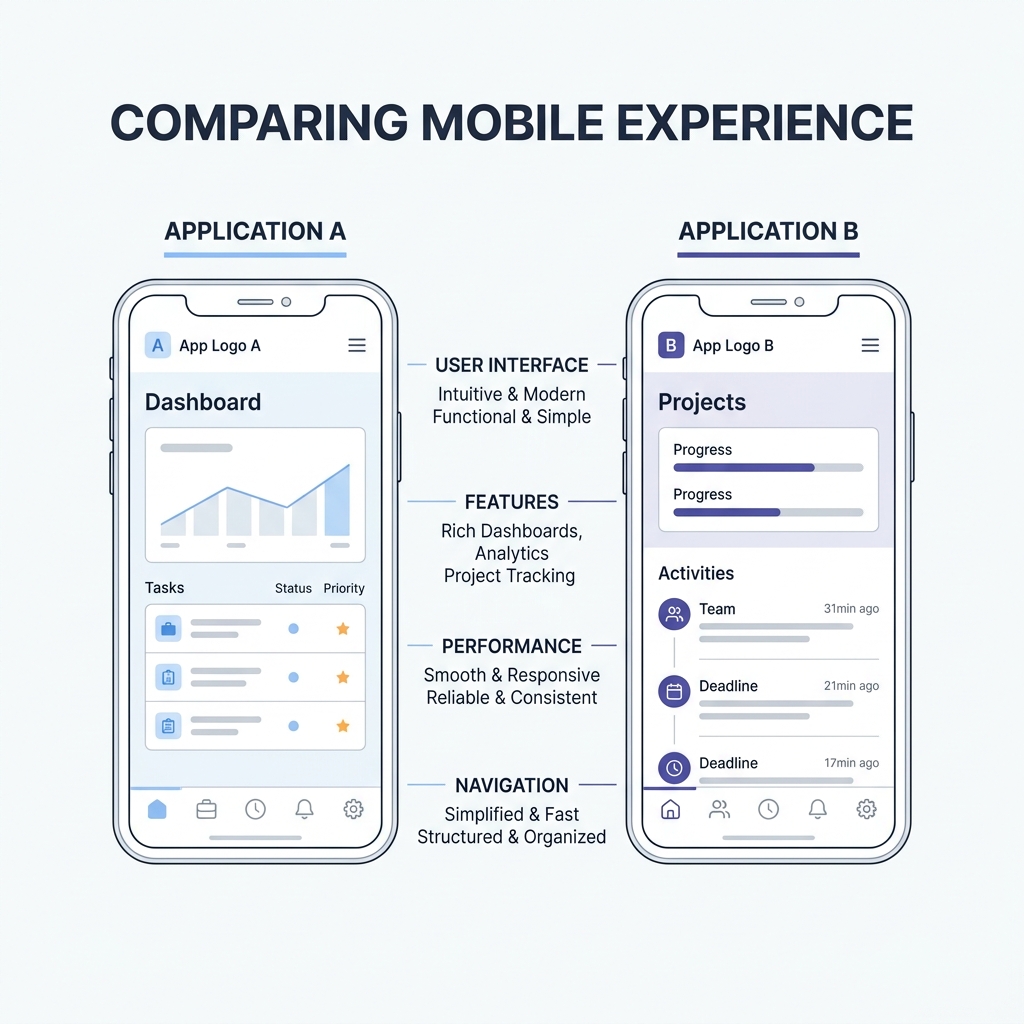
An objective architectural comparison of Flutter vs React Native for startup MVPs and scalable enterprise applications.
Choosing between Flutter and React Native remains one of the most strategic architectural decisions for engineering leads in 2026. Both cross-platform frameworks enable a single codebase to target iOS and Android, but their underlying render engines, state models, and ecosystem characteristics differ fundamentally.
Section 2
Architecture & Rendering Engines - **React Native (New Architecture - Fabric & TurboModules)**: React Native leverages native platform controls via JSI (JavaScript Interface), bypassing legacy bridge bottlenecks. It renders true native iOS (UIKit) and Android (Android Views) widgets, ensuring compliance with OS design guidelines. - **Flutter (Impeller Render Engine)**: Flutter uses Impeller (Google’s hardware-accelerated 2D renderer) to draw every pixel directly via Metal on iOS and Vulkan on Android. This guarantees 60fps/120fps visual consistency across all screen sizes.
Section 3
Developer Experience & Ecosystem Maturity React Native dominates in web-to-mobile code sharing, especially for teams proficient in React and TypeScript. Its vast npm ecosystem and Expo tooling make iteration rapid. Flutter, powered by Dart, provides an out-of-the-box UI widget library and strong sound null-safety type guarantees.
ApperDev Engineering Consultation
Planning a Engineering project?
Book a free strategy session with our senior architects to evaluate your technical scope, UI requirements, and timeline estimates.
Section 4
Performance Benchmarks For standard CRUD apps, e-commerce, and dashboards, performance differences between React Native and Flutter are negligible. However, Flutter excels in complex vector canvas animations and custom graphical charts, while React Native leads when deep integration with native SDKs and native background workers is required.
Section 5
The Verdict: How to Decide for Your Project Choose **React Native** if your web app is built on React, or if you plan to share state/types between web and mobile. Choose **Flutter** if your application demands intricate custom UI controls, high-framerate animations, or visual uniformity across desktop, mobile, and web.
“The framework decision shouldn’t be based on developer hype, but on your team’s ecosystem, native module requirements, and long-term UI requirements.”
Partner with ApperDev
Ready to build your next mobile app?
From initial product strategy and UI/UX design systems to high-performance Flutter & React Native engineering.
Start a conversation with our team ↗#Flutter#React Native#Cross-Platform#Mobile Engineering